November 8, 2025
The First Stage of Ānāpānasati is stated with only a few verses in the Ānāpānasati Sutta. We will discuss them in detail.
Verses in the Ānāpānasati Sutta
1. The following verses are in the Ānāpānasati Sutta. I quoted them as the first stage of Ānāpānasati in #3 of “Ānāpānasati – Connection to Satipaṭṭhāna.” That post separated the verses in the Ānāpānasati Sutta into three stages. The second stage involves Satipaṭṭhāna.
▪Kathaṁ bhāvitā ca, bhikkhave, ānāpānassati kathaṁ bahulīkatā mahapphalā hoti mahānisaṁsā? (How do you cultivate Ānāpānassati to attain magga phala (especially the Sotāpanna stage)?
Idha, bhikkhave, bhikkhu araññagato vā rukkhamūlagato vā suññāgāragato vā nisīdati pallaṅkaṁ ābhujitvā ujuṁ kāyaṁ paṇidhāya parimukhaṁ satiṁ upaṭṭhapetvā. So satova assasati satova passasati.
Dīghaṁ vā assasanto ‘dīghaṁ assasāmī’ti pajānāti, dīghaṁ vā passasanto ‘dīghaṁ passasāmī’ti pajānāti; rassaṁ vā assasanto ‘rassaṁ assasāmī’ti pajānāti, rassaṁ vā passasanto ‘rassaṁ passasāmī’ti pajānāti; ‘sabbakāyapaṭisaṁvedī assasissāmī’ti sikkhati, ‘sabbakāyapaṭisaṁvedī passasissāmī’ti sikkhati; ‘passambhayaṁ kāyasaṅkhāraṁ assasissāmī’ti sikkhati, ‘passambhayaṁ kāyasaṅkhāraṁ passasissāmī’ti sikkhati. (This is the basic version of Kāyānupassanā)
‘Pītipaṭisaṁvedī assasissāmī’ti sikkhati, ‘pītipaṭisaṁvedī passasissāmī’ti sikkhati; ‘sukhapaṭisaṁvedī assasissāmī’ti sikkhati, ‘sukhapaṭisaṁvedī passasissāmī’ti sikkhati; ‘cittasaṅkhārapaṭisaṁvedī assasissāmī’ti sikkhati, ‘cittasaṅkhārapaṭisaṁvedī passasissāmī’ti sikkhati; ‘passambhayaṁ cittasaṅkhāraṁ assasissāmī’ti sikkhati, ‘passambhayaṁ cittasaṅkhāraṁ passasissāmī’ti sikkhati. (This is the basic version of Vedanānupassanā)
‘Cittapaṭisaṁvedī assasissāmī’ti sikkhati, ‘cittapaṭisaṁvedī passasissāmī’ti sikkhati; ‘abhippamodayaṁ cittaṁ assasissāmī’ti sikkhati, ‘abhippamodayaṁ cittaṁ passasissāmī’ti sikkhati; ‘samādahaṁ cittaṁ assasissāmī’ti sikkhati, ‘samādahaṁ cittaṁ passasissāmī’ti sikkhati; ‘vimocayaṁ cittaṁ assasissāmī’ti sikkhati, ‘vimocayaṁ cittaṁ passasissāmī’ti sikkhati. (This is the basic version of Cittānupassanā)
‘Aniccānupassī assasissāmī’ti sikkhati, ‘aniccānupassī passasissāmī’ti sikkhati; ‘virāgānupassī assasissāmī’ti sikkhati, ‘virāgānupassī passasissāmī’ti sikkhati; ‘nirodhānupassī assasissāmī’ti sikkhati, ‘nirodhānupassī passasissāmī’ti sikkhati; ‘paṭinissaggānupassī assasissāmī’ti sikkhati, ‘paṭinissaggānupassī passasissāmī’ti sikkhati. (This is the basic version of Dhammānupassanā)
▪Evaṁ bhāvitā kho, bhikkhave, ānāpānassati evaṁ bahulīkatā mahapphalā hoti mahānisaṁsā. (That is how to cultivate ānāpānassati to attain the Sotāpanna stage)
Meaning of Those Verses
2. First, let me provide the gist of those verses. Then we will make a connection to the previous post, “First Stage of Ānāpānasati – Seeing the Anicca Nature of ‘Kāya’ ” where I pointed out the key concepts involved.
▪How do you cultivate Ānāpānassati to attain magga phala (especially the Sotāpanna stage)?
A bhikkhu should go to an appropriate place free of disturbances to cultivate Ānāpānasati. This could be an arañña (where only bhikkhus live), or to the root of a tree, or to an empty hut—sits down cross-legged, sets their body straight, and makes an effort to establish Sammā Sati.
The goal is to stay away from kāya saṅkhāra (all saṅkhāra associated with the pañcupādānakkhandha kāya), calm the mind, and move it toward the Satipaṭṭhāna Bhūmi. One would know (pajānāti) when one is able to keep the mind steady on that effort for long times (Dīghaṁ vā assasanto ‘dīghaṁ assasāmī’ti pajānāti, dīghaṁ vā passasanto ‘dīghaṁ passasāmī’ti pajānāti), and one would also know when the mind faces disturbances and is able to keep it focused only for short times (rassaṁ vā assasanto ‘rassaṁ assasāmī’ti pajānāti, rassaṁ vā passasanto ‘rassaṁ passasāmī’ti pajānāti). With the comprehension of the pañcupādānakkhandha kāya, one trains (sikkhati) by recalling the instructions (sabbakāya paṭisaṁvedī assasissāmī’ti sikkhati) and then ‘seeing that with wisdom’ (sabbakāyapaṭisaṁvedī passasissāmī’ti sikkhati). That leads to the calming down and cessation of ‘kāya saṅkhāra’ or all saṅkhāra associated with the pañcupādānakkhandha kāya (passambhayaṁ kāyasaṅkhāraṁ assasissāmī’ti sikkhati, ‘passambhayaṁ kāyasaṅkhāraṁ passasissāmī’ti sikkhati).
▪The above is the basic version of Kāyānupassanā.
When engaging in Kāyānupassanā (basically stopping the ‘nava kamma’ stage (with strong kāya saṅkhāra) altogether and moving it along the ‘purāṇa kamma’ stage toward the Satipaṭṭhāna Bhūmi), one starts to feel the ‘nirāmisa sukha’ increasing. That is what is expressed in the verses describing Vedanānupassanā. There, ‘pīti’ is not the ‘pīti’ associated with enjoying sensory pleasures (‘āmisa version’); it is the ‘nirāmisa version.’ Thus, “Pītipaṭisaṁvedī assasissāmī’ti sikkhati, ‘pītipaṭisaṁvedī passasissāmī’ti sikkhati” means one trains (sikkhati) while experiencing that ‘nirāmisa pīti.’ After ‘nirāmisa pīti, ’ one would experience ‘nirāmisa sukha.’ By that time, the mind should advance to the ‘purāṇa kamma’ stage (i.e., no more ‘nava kamma’ while in that meditation session). While in the ‘nava kamma’ stage, the mind experienced stronger ‘mano saṅkhāra,’ but now it will experience less potent ‘citta saṅkhāra.’ Thus, one would now train with a clearer mind in the ‘purāṇa kamma’ stage.
▪The above is the basic version of Vedanānupassanā.
Cittānupassanā: dispelling one’s defiled thoughts with rāga, dosa, moha, and focusing on nekkhamma, avyāpāda, avihimsā thoughts happens automatically while listening to a good discourse or while contemplating; that is how one attains the Sotāpanna stage. Then the mind becomes energized (‘abhippamodayaṁ cittaṁ’) and gets to ‘samādhi’ (‘samādahaṁ cittaṁ’), eventually leading to becoming free (‘vimocayaṁ’) of the ‘kāma saññā’ and migrating to the Satipaṭṭhāna bhūmi (vimocayaṁ cittaṁ).
▪The above is the BASIC version of Cittānupassanā.
Simultaneously with the above three processes, Dhammānupassanā also takes place while listening to a good discourse or while contemplating previously learned Dhamma concepts on the anicca nature, i.e., the unfruitfulness and dangers of attaching to pañcupādānakkhandha kāya. That leads to the mind becoming free of rāga (‘virāgānupassi’), cessation (‘nirodha’) of them, and leading to the breaking of at least the first three diṭṭhi saṁyojana (‘paṭinissagga’).
▪Thus, the culmination of the four types of anupassanā leads to the Sotāpanna phala moment.
The above description provides a bit more detail about reaching the Sotāpanna stage. Many suttas examine the process from different angles, and we have already discussed them; I will refer to them starting with #6 below. But first, let me briefly discuss a key phrase in the discussion above.
“Passambhayaṁ Kāyasaṅkhāraṁ” – Two Meanings
3. In Kāyānupassanā, the phrase, ‘passambhayaṁ kāyasaṅkhāraṁ’ refers to calming of the ‘saṅkhāra generation’ (in the ‘nava kamma’ stage and also in the ‘purāṇa kamma’ stage), leading to calming the mind.
▪In the “WebLink: suttacentral: Mahānāma Sutta (AN 6.10),” the Buddha describes to Mahānāma (a rich lay disciple who attained the Sotāpanna stage) how the mind of a puthujjana cultivates faith in the Buddha, Dhamma, and Saṅgha and attains the Sotāpanna phala.
▪That is the moment when the joyful mind leads to the calming of ‘kāya saṅkhāra.’ At marker 7.11: “Pamuditassa pīti jāyati, pītimanassa kāyo passambhati, passaddhakāyo sukhaṁ vediyati, sukhino cittaṁ samādhiyati.” Next, passaddha kāya (meaning the calm pañcupādānakkhandha kāya) leads to ‘nirāmisa sukha’ (‘sukhaṁ vediyati’), which, in turn, leads to samādhi (‘sukhino cittaṁ samādhiyati’).
▪Thus, ‘passambhayaṁ kāyasaṅkhāraṁ’ means calming of the ‘saṅkhāra generation’ (in the ‘nava kamma’ stage and also in the ‘purāṇa kamma’ stage).
4. The Mahānāma Sutta does not discuss how one cultivates that ‘unbreakable faith (saddhā) in the Buddha, Dhamma, and Saṅgha. That is done by comprehending the ‘anicca nature’ of the world as taught by the Buddha. That is succinctly stated in the first stage of Ānāpānasati as discussed above.
▪That happens when one contemplates the ‘anicca nature’ while engaging in the cultivation of the four types of anupassanā (kāyānupassanā, cittānupassanā, vedanānupassanā, and dhammānupassanā) as stated in the Ānāpānasati Sutta and also at the beginning of the Mahā Satipaṭṭhāna Sutta.
5. Thus, ‘passambhayaṁ kāyasaṅkhāraṁ’ refers to calming of the ‘saṅkhāra generation’ in the first stage of Ānāpānasati.
▪However, the same verse ‘passambhayaṁ kāyasaṅkhāraṁ’ has a different meaning in the second stage of Ānāpānasati. We will discuss it later.
▪Now, let us discuss further details of the first stage of Ānāpānasati.
The ‘Paṭisotagāmi’ Process in Becoming a Sotāpanna
6. The above process (in #2 above) of reaching the Sotāpanna stage was discussed in detail in the previous post, “First Stage of Ānāpānasati – Seeing the Anicca Nature of ‘Kāya’.”
▪Thus, the Ānāpānasati Sutta outlines only the key steps, without providing details.
▪I hope you can get an idea of how misleading most present-day English translations are: “WebLink: suttacentral: Ānāpānasati Sutta (MN 118)” by comparing with the above.
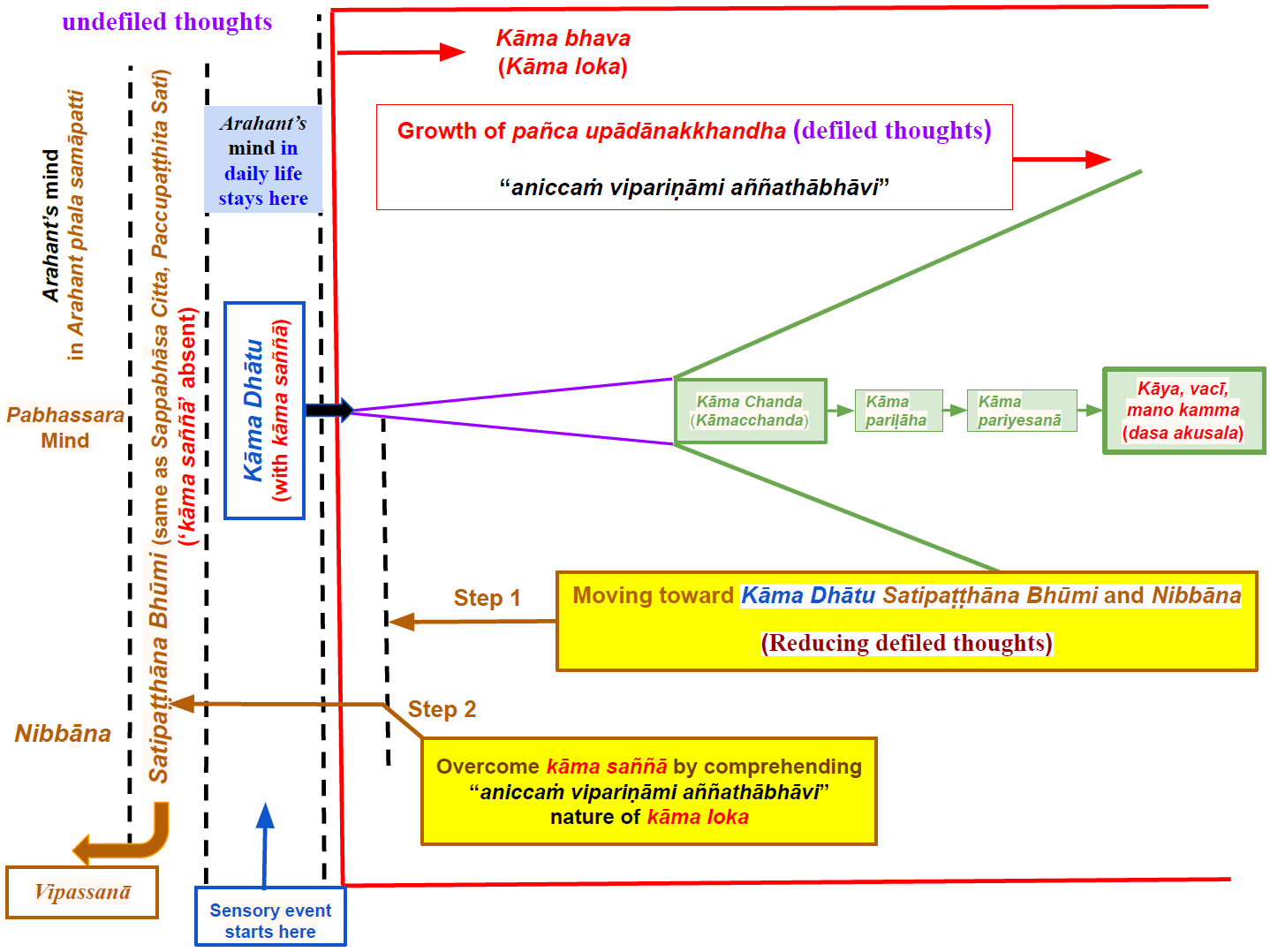
▪Hopefully, now one can connect to the following chart from #5 of the above post.
Aniccaṁ vipariṇāmi aññathābhāvi
Print/Download: “WebLink: PDF Download: Aniccaṁ vipariṇāmi aññathābhāvi”
▪Both Step 1 and Step 2 can take place while engaging in the first stage of Ānāpānasati (kāyānupassanā, cittānupassanā, vedanānupassanā, and dhammānupassanā).
▪A puthujjana (or a Sotāpanna Anugāmi) attains the Sotāpanna phala moment while briefly in the Satipaṭṭhāna Bhūmi. It takes only the duration of a lightning flash in the Satipaṭṭhāna Bhūmi to attain the phala moment; see, “WebLink: suttacentral: Vajirūpama Sutta (AN 3.25).” The three types of people are a puthujjana, a Sotāpanna, and an Arahant.
▪To be able to access the Satipaṭṭhāna Bhūmi on a regular basis, a Sotāpanna must cultivate the second stage of Ānāpānasati. We will discuss that in upcoming posts.
It Can Happen During a Discourse or While Contemplating (Vipassanā)
7. One can reach the Sotāpanna stage by going through the above steps in a relatively short time.
▪When the mind focuses on a Dhamma concept, it becomes free of the ‘nava kamma’ stage and starts moving toward the Satipaṭṭhāna Bhūmi.
▪Many people attained the Sotāpanna stage while listening to a single discourse by the Buddha. Even a person who was a mass murderer (Aṅgulimāla) attained the Sotāpanna stage within an hour of meeting the Buddha. See, “Account of Aṅgulimāla – Many Insights to Buddha Dhamma.”
▪Unless one has done an ānantarika kamma, one can attain the Sotāpanna stage in this life. See “Ānantarika Kamma – Connection to Gandhabba.”
▪Further details on reaching the Sotāpanna stage in “Paṭisotagāmī – Moving Toward Satipaṭṭhāna Bhūmi and Nibbāna,” “What Does ‘Paccaya’ Mean in Paṭicca Samuppāda?” and “Sotāpanna Anugāmi and Anicca/Vipariṇāmi Nature of a Defiled Mind.”
Stopping the ‘Nava Kamma’ Stage
8. Let us examine how a mind can stop the ‘nava kamma’ stage for even a couple of hours.
▪If the mind can be focused on a single object (that does not trigger rāga or dosa), it cannot be involved in most of the dasa akusala. It wouldn’t be thinking about committing one of the three akusala kamma via the body (killing, stealing, sexual misconduct) or the four via speech (lying, frivolous talk, slandering, or harsh speech). It also wouldn’t be engaged with two of the three done by the mind: greed for others’ belongings (abhijjhā) and ill-will (vyāpāda) toward others. See “Ten Immoral Actions (Dasa Akusala).”
▪That would work by focusing the mind on the breath (anariya ‘breath meditation’) or on a neutral object, like a ball of clay or a fire (anariya kasiṇa meditation).
▪The same holds true while attentively listening to a discourse or while deeply immersed in insight meditation (Vipassanā).
Overcoming the ‘Kāma Saññā’
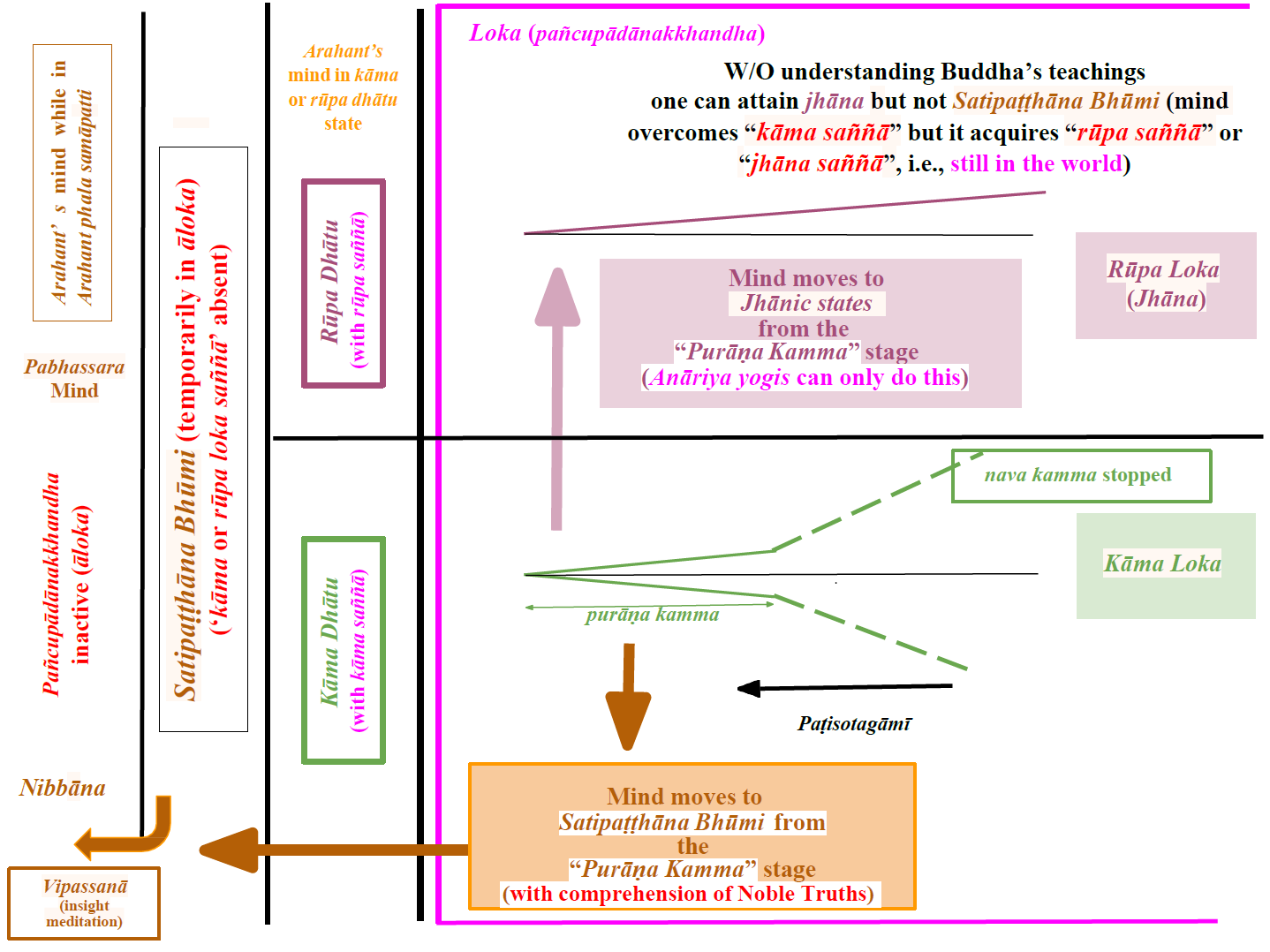
9. Since the mind is not focusing on a ‘mind-pleasing’ or ‘mind-agitating’ subject, it can proceed backward (toward the Satipaṭṭhāna Bhūmi) in the ‘purāṇa kamma’ stage; see the chart above.
▪However, the tenth one, micchā diṭṭhi (wrong views), would still be associated with a puthujjana who has not yet eliminated the ten wrong views, including not believing in the laws of kamma and rebirth; see “Micchā Diṭṭhi, Gandhabba, and Sotāpanna Stage.” Therefore, they cannot get close to the beginning of the ‘purāṇa kamma’ stage.
▪Most anariya yogis (especially in the time of the Buddha) had removed the ten types of wrong views. Thus, they and those puthujjana who have eliminated the ten types of wrong views CAN approach the beginning of the ‘purāṇa kamma’ stage.
Overcoming the ‘Kāma Saññā’ – Two Possibilities
10. Now, being close to the beginning of the ‘purāṇa kamma’ stage, their minds are almost free of the ‘kāma loka.’ There are two possibilities at that point.
i.One can overcome the kāma saññā to move up to rūpa saññā corresponding to rūpa loka (i.e., attain a jhāna) “within the world.”
ii.The other is to overcome the kāma saññā with wisdom (paññā) to progress into the Satipaṭṭhāna Bhūmi and attain the Sotāpanna phala moment.
▪The second option is possible only for a puthujjana (or a Sotāpanna Anugāmi) listening to a discourse on the ‘anicca nature’ of the world, or one who has already heard it and is contemplating on it, i.e., engaged in Vipassanā.
▪That was discussed in the post, “Overcoming Kāma Saññā – Satipaṭṭhāna Bhūmi or Jhāna.” The following chart from that post explains the situation.
Overcoming Kāma Saññā - Satipaṭṭhāna Bhūmi or Jhāna
Download/Print: “WebLink: PDF file download: Overcoming Kāma Saññā – Satipaṭṭhāna Bhūmi or Jhāna”
▪Those minds that become free of the kāma saññā to move to the rūpa loka, i.e., to the first jhāna. They can move up that ladder through all the rūpa loka jhāna and arūpa loka samāpatti to the highest arūpa loka samāpatti. That is all an anariya yogi can achieve. However, a Noble Person attaining that highest arūpa loka samāpatti can attain Arahanthood there. Those are ubhatobhāgavimutta Arahants, who can access ‘nirodha samāpatti.’ See #16 of “What is Suñyāta or Suññāta (Emptiness)?”
▪On the other hand, one who gets into the Satipaṭṭhāna Bhūmi can attain the Sotāpanna stage. Subsequently, they can cultivate the second stage of Ānāpānasati (i.e., Satipaṭṭhāna) to attain higher magga phala.
Attaining the Sotāpanna Phala
11. Even though most people attained the Sotāpanna stage while listening to a single discourse by the Buddha, attaining the Sotāpanna phala moment can happen anytime, anywhere, while contemplating. Of course, one must have learned the necessary Dhamma concepts (especially the ‘anicca nature’ of the world) from a Noble Person (an Ariya).
▪The “WebLink: suttacentral: Vimuttāyatana Sutta (AN 5.26)” describes five ways of attaining magga phala: (i) while learning Dhamma from a Noble teacher, (ii) while the person himself teaches Dhamma to others, (iii) and (iv) while the person is contemplating in detail Dhamma concepts learned from a Noble teacher. and (v) while fully immersed in a meditation subject (samādhi nimitta). Note that (ii) and (v) hold only for a Noble Person attaining higher magga phala. The other three also hold for puthujjana striving for the Sotāpanna stage.
▪Therefore, what matters is grasping the relevant Dhamma concepts and breaking the respective saṁyojana.
▪We can look at two accounts from the Tipiṭaka to verify the above. Venerable Koṇḍañña attained the Sotāpanna phala moment while contemplating the Dhamma he learnt from the first discourse delivered by the Buddha. Another is that of Ven. Cittahattha attained the Sotāpanna phala moment while walking to the monastery to become a bhikkhu for the seventh time; along the way, he reflected on the Dhamma he had learned and realized the Sotāpanna phala. See “Four Conditions for Attaining Sotāpanna Magga/Phala.”
Setting Aside a Day for the Effort
12. Therefore, one could, in principle, attain the Sotāpanna stage within an intensely focused effort within even a day.
▪As we have discussed, it requires: (i) learning about the ‘anicca nature’ of the world from a Buddha or a true disciple of the Buddha (a Noble Person) and then (ii) fully comprehending it with wisdom.
▪Those two steps are called ‘jānato’ (come to know about) and ‘passato’ (seeing the truth of that with ‘dhamma cakkhu’ or ‘with wisdom’).
▪See “‘Jānato Passato’ and Ājāniya – Critical Words to Remember.”
Uposatha Sutta
13. This is why it is customary in the Buddhist countries to allocate a day (usually the Full Moon Day each month) to focus on this objective. They usually observe the ‘eight precepts’ or even the ‘ten precepts.’
▪They spend the day listening to discourses and engaging in Vipassanā.
▪In the days of the Buddha, this was called ‘uposatha.’ It can also be done to attain higher magga phala for a Sotāpanna.
▪The Buddha explained to Visākhā how to practice the correct version of ‘uposatha’ in the “WebLink: suttacentral: Uposatha Sutta (AN 3.70).” Apparently, there were two other wrong versions practiced at the time.
▪Note that ‘uposatha’ is translated as ‘Sabbath’ in the English translation. In Abrahamic religions, the Sabbath is a day set aside for rest and worship. That does not convey the meaning of Buddhist ‘uposatha.’
▪The correct version of the ‘uposatha’ description starts at marker 4.1.
All recent posts in the “Satipaṭṭhāna Sutta – New Series” section.