December 20, 2025; revised and added #16 later in the day
Before we start consciously accumulating potent kamma in the ‘nava kamma’ stage, the mind is contaminated automatically in two steps in the ‘purāṇa kamma’ stage. The first is to generate ‘rāga’ via automatic attachment to saññā based on the five lower saṁyojana. The second step is to attach firmly (taṇhā) via kāmacchanda to the sensory input based on ‘kāma guṇa’ generated in the mind based on one’s mindset (gati) at that moment.
Introduction
1. The initial attachment to a sensory event occurs with automatically-arising saññā, and not strictly vedanā (even though it is hard to separate saññā and vedanā there). We discussed that ‘initial automatic attachment’ step in “Origin of Attachment – Rāga Triggered by Saññā.” That initiates the ‘purāṇa kamma’ or the ‘initial kamma formation’ stage. Note that ‘purāṇa’ does not mean ‘old,’ but rather, ‘initial.’
▪Before we become aware of the sensory event, the mind undergoes several additional steps in the ‘purāṇa kamma’ stage, becoming increasingly contaminated within a split second. It would transition to the ‘nava kamma’ stage only if the sensory input generates sufficient ‘kāma guṇa’ in the mind. This is when ‘rāga’ (subtle, weak attachment) leads to ‘chanda’ (liking) and advances to ‘kāmacchanda’ and ‘kāma rāga’ (stronger attachment) in the second critical step, while still in the ‘purāṇa kamma’ stage.
▪We become aware of the sensory event only after the mind reaches the ‘nava kamma’ stage; the mind goes through the ‘purāṇa kamma’ stage within a split second.
▪Only a Buddha can uncover this ‘hidden aspect’ (‘purāṇa kamma’ stage) of the mind. This is why Buddha Dhamma is “previously unheard teachings of a Buddha” or ‘pubbe anaussutesu dhammsu.’ The verse, ‘pubbe ananussutesu dhammesu cakkhuṁ udapādi, ñāṇaṁ udapādi, paññā udapādi, vijjā udapādi, āloko udapādi,’ appears many times in the first discourse of the Buddha: “WebLink: suttacentral: Dhammacakkappavattana Sutta (SN 56.11).” It is impossible to attain Nibbāna until one comprehends this critical aspect.
Mind Contamination at the Beginning of the Purāṇa Kamma Stage
2. As we discussed in “Origin of Attachment – Rāga Triggered by Saññā,” the initial attachment is automatic and depends only on the number of unbroken saṁyojana. We discussed those steps using the “WebLink: suttacentral: Saññānānatta Sutta (SN 14.7)”:
i.First, the mind receives an imprint of the ‘unaltered external rūpa’ (as it exists in the external world, without colors, tastes, etc.) from the brain. This is the rūpa dhātu, which triggers rūpa saññā: ‘Rūpa dhātuṁ, bhikkhave, paṭicca uppajjati rūpa saññā’ or ‘The rūpa dhātu gives rise to (or triggers) the (distorted) perception (with colors, tastes, etc.).’
ii.‘Rūpasaññaṁ paṭicca uppajjati rūpasaṅkappo’: leads to bahiddha rūpa, where the mind automatically attaches to that mind-made rūpa with (distorted) saññā. All others also move to the ‘bahiddha’ stage, i.e., cakkhu dhātu becomes ‘bahiddha cakkhu’ and ‘cakkhu viññāṇa dhātu’ becomes ‘bahiddha cakkhu viññāṇa.’ By the way, bahiddha rūpa and bahiddha cakkhu are included in ‘bahiddha rūpa upādānakkhandha.’
iii.In the next step, all those advance to the ‘ajjhatta’ stage (with ‘ajjhatta cakkhu viññāṇa’), with the mind ‘seeing the bahiddha rūpa’ as real (with some to be enjoyable and others to be disliked, but even the ‘neutral rūpa’ being ‘real,’ i.e., having colors, tastes, etc.). This is the ‘rūpasaṅkappaṁ paṭicca uppajjati rūpacchando’ step in the sutta.
iv.But many features of the ‘rūpa’ experienced are not in ‘external rūpa’ as mentioned in (i) above. For example, color or taste are not in external rūpa; see “The Illusion of Perception (Saññā) – It Is Scientific Consensus.”)
3. By this time, the ‘cakkhuñca paṭicca rūpe ca uppajjati cakkhuviññāṇaṁ’ step is complete, and cakkhu viññāṇa has arisen. Also, PS is at the “saṅkhāra paccayā viññāṇa’ step, with ‘viññāṇa’ being the ‘cakkhu viññāṇa’ (for a ‘seeing event’).
▪The “WebLink: suttacentral: Kammanirodha Sutta (SN 35. 146)” states, “Cakkhu, bhikkhave, purāṇakammaṁ abhisaṅkhataṁ abhisañcetayitaṁ vedaniyaṁ daṭṭhabbaṁ …pe…”
▪That means: Cakkhu (cakkhu āyatana or cakkhāyatana) and all other five internal (ajjhatta) āyatana (sota, gandha, jivhā, kāya, mano) are ‘initial (purāṇa) kamma’ that are automatically generated via abhisaṅkhāra generation (some are saṅkappa) automatically arising due to unbroken saṁyojana. The five external (bāhira) āyatana (rūpa, sadda, gandha, rasa, poṭṭhabba, dhammā) have also arisen. Thus, all twelve āyatana have now arisen. Note that bāhira and bahiddha mean different things.
▪The only way to stop that is to break those saṁyojana by cultivating the Noble Path (where Satipaṭṭhāna plays a key role).
▪Mind contamination up to this point occurs with all sensory inputs, unless the lowest five saṁyojana have been eliminated.
▪However, mind contamination in the latter step of the ‘purāṇa kamma’ stage depends on one’s mindset (or ‘gati’) at that moment, and thus, could be stopped. This second step is discussed in the section below, starting in #5.
▪Note: In some suttās, it is stated that ‘dukkha samudaya’ (arising of suffering) starts with the ‘cakkhuñca paṭicca rūpe ca uppajjati cakkhuviññāṇaṁ’ step; see “WebLink: suttacentral: Dukkhasamudaya Sutta (SN 35.106),” “WebLink: suttacentral: Lokasamudaya Sutta (SN 35.107),” and “WebLink: suttacentral: Chachakka Sutta (MN 148).” This may explain why many people are unaware of the ‘purāṇa kamma’ stage.
Connection to Satipaṭṭhāna – Kāye Kāyānupassanā
4. One must have understood the above-discussed first step in the ‘purāṇa kamma’ stage to cultivate Satipaṭṭhāna. In particular, cultivation of Kāye Kāyānupassanā requires understanding what ‘kāye kāya’ and the two types of ‘kāya’ in ‘kāye kāya’ (‘kāya’ within ‘kāya’).
▪There, ‘kāye kāya’ is the above-discussed very first stage of the whole pañcupādānakkhandha kāya (most times referred to as only ‘kāya’ in the suttās).
▪The two types of ‘kāya’ in ‘kāye kāya’ are the ajjhatta kāya and bahiddha kāya.
▪The bahiddha kāya arises first with bahiddha rūpa, bahiddha vedanā, bahiddha saññā, bahiddha saṅkhāra (which are saṅkappa), and bahiddha viññāṇa (the five entities associated with that stage).
▪Then ‘chanda’ arises (with ‘rūpasaṅkappaṁ paṭicca uppajjati rūpacchando’), leading to the ajjhatta kāya with the five entities (rūpa, vedanā, saññā, saṅkhāra, and viññāna) associated with that stage.
▪These are the two stages referred to in @maker 2.11 in the Mahā Satipaṭṭhāna Sutta: “Iti ajjhattaṁ vā kāye kāyānupassī viharati, bahiddhā vā kāye kāyānupassī viharati, ajjhattabahiddhā vā kāye kāyānupassī viharati.”
▪See #13 of “Kāye Kāyānupassanā – Details in Satipaṭṭhāna.”
Mind Contamination at the Second Step in Purāṇa Kamma
5. Now, let us discuss the second step in the ‘purāṇa kamma’ stage. In this step, the mind (cakkhu viññāṇa) prepares ‘an even more contaminated version of the external rūpa’ (called ‘cakkhuvinneyya rūpa’) by recalling past experiences with similar rūpa and future expectations for similar rūpa. During that process, the mind will ‘expand’ to involve not only the cakkhu viññāṇa, but all six types of viññāṇa (via the ‘viññāṇa paccayā nāmarūpa’ and ‘nāmarūpa paccayā salāyatana’ steps).
▪Therefore, it is a complex process (even though it occurs within a split second) involving all twelve āyatana (salāyatana) and the formation of nāmarūpa.
▪The mind will incorporate relevant past experiences and future expectations and form its own version of the ‘external rūpa.’
▪As we have discussed, the initial ‘bahiddha rūpa’ generation was already affected by the (distorted saññā); now, that ‘rūpa’ becomes even more ‘distorted’ and incompatible with reality.
6. Details of this second contamination process depend on the ‘level of importance of that ‘ajjhatta rūpa’ arising in the ‘cakkhu viññāṇa’ (for a ‘seeing event’). This evaluation depends on the mindset of the person at that moment and also on the level of importance of that ‘rūpa’ as determined by the ‘kāma guṇa’ attributed to it.
▪The Sanidāna Sutta describes this process for any sensory input, by considering ‘kāma dhātu’ (which incorporates all six types of rūpa) instead of a ‘specific rūpa dhātu’ (which was the case in the Saññānānatta Sutta (SN 14.7) discussed in #2 above.
▪“WebLink: suttacentral: Sanidāna Sutta (SN 14.12)”: “Kāmadhātuṁ, bhikkhave, paṭicca uppajjati kāmasaññā, kāmasaññaṁ paṭicca uppajjati kāmasaṅkappo, kāmasaṅkappaṁ paṭicca uppajjati kāmacchando, kāmacchandaṁ paṭicca uppajjati kāmapariḷāho, kāmapariḷāhaṁ paṭicca uppajjati kāmapariyesanā.”
▪Thus, the ‘Rūpa dhātuṁ, bhikkhave, paṭicca uppajjati rūpa saññā’ and ‘rūpasaññaṁ paṭicca uppajjati rūpasaṅkappo’ in the Saññānānatta Sutta (SN 14.7) are replaced by ‘Kāmadhātuṁ, bhikkhave, paṭicca uppajjati kāmasaññā’ and ‘kāmasaññaṁ paṭicca uppajjati kāmasaṅkappo’ in the Sanidāna Sutta (SN 14.12).
▪Therefore, those two steps belong to the initial step in the ‘purāṇa kamma’ stage discussed in the previous post, “Origin of Attachment – Raga Triggered by Saññā.”
▪Now, let us discuss the subsequent steps.
7. The next mind-contamination step is, ‘kāma saṅkappaṁ paṭicca uppajjati kāmacchando.’ This is where stronger kāmacchanda is generated.
▪That step occurs only for sensory events that the mind perceives as ‘important.’ Most of the things we see, hear, etc., are ignored by the mind; for example, we see and hear many things during the day, which we ignore, like seeing the sky, random trees, hearing random sounds, etc. )
▪Those events that ‘capture our minds’ are those having ‘enticing aspects’ called ‘kāma guṇa.’
▪Also see “Taṇhā – Result of Saññā Giving Rise to Mind-Made Vedanā.”
Six Types of Kāma Guṇa
8. Those ‘kāma guṇa’ are defined in the “WebLink: suttacentral: Kāmaguṇa Sutta (SN 45.176)” and explained in detail in the “WebLink: suttacentral: Kāmaguṇa Sutta (SN 35.117).”
▪As stated in the first sutta above, there are five types of kāma guṇa, i.e., they can arise with any of the five physical sense faculties of cakkhu, sota, ghāna, jivhā, kāya. Thus, they are ‘enhanced/further contaminated rūpa’ generated via cakkhu viññāṇa through kāya viññāṇa: Cakkhuviññeyyā rūpā, sotaviññeyyā saddā, ghānaviññeyyā gandhā, jivhāviññeyyā rasā, kāyaviññeyyā phoṭṭhabbā. Thus, cakkhuviññeyyā rūpā means a ‘rūpa prepared by cakkhu viññāṇa.’
▪Those rūpa have one or more of six enticing characteristics (kāma guṇa): “iṭṭhā kantā manāpā piyarūpā kāmūpasaṁhitā rajanīyā.”
9. The first one, iṭṭhā, means “promise of fulfillment,” which goes with our perceived “nicca nature of this world.” However, the world is of anicca nature, and thus, this “iṭṭhā characteristic” is based on the ignorance of the true, fundamental nature. For example, even though objects in the external world do not have colors, tastes, etc., the ‘rūpa’ generated by the mind has colors, tastes, etc., which are generated via saññā. see “The Illusion of Perception (Saññā) – It Is Scientific Consensus.”
▪The three characteristics kantā, manāpā, and piyarūpā express similar meanings: desirable, agreeable, and pleasant (and emphasize the iṭṭhā characteristic). The fifth, “kāmūpasaṁhitā,” means “induce sensuality.” The last one, “rajanīyā,” means “generating defilements” and thus can make one do immoral things to fulfill one’s desires.
▪Those characteristics are described in detail in “Kama Guṇa – Origin of Attachment (Taṇhā).”
▪Also note that dosa arises (dosūpasaṁhitā) due to the opposite characteristics of ‘aniiṭṭhā akantā amanāpā appiyarūpā’; see “WebLink: suttacentral: Mahāsatipaṭṭhāna Sutta (DN 22).” Strong Attachment (taṇhā) can occur due to ‘kāmūpasaṁhitā, dosūpasaṁhitā, and mohūpasaṁhitā’ or via rāga, dosa, and moha. See “WebLink: suttacentral: Vitakkasaṇṭhāna Sutta (MN 20).”
▪Most suttās explain the ‘rāga’ aspect, but those concepts also apply to the other two.
‘Mind-Prepared Rūpa’ Are Like Six Hooks
10. “WebLink: suttacentral: Bāḷisikopama Sutta (SN 35.230)” describes how a fish swallows a ‘tasty bait’ attached to a hook and is subjected to much suffering.
▪At marker 2.1: ‘In the same way, there are these six hooks in the world that mean tragedy and slaughter for living creatures.’
▪In the same way, there are ‘sights perceived with the cakkhu āyatana’ (cakkhuviññeyyā rūpā), which are likable, desirable, agreeable, pleasant, sensual, and arousing (‘iṭṭhā kantā manāpā piyarūpā kāmūpasaṁhitā rajanīyā’). If a bhikkhu approves, welcomes, and keeps clinging to them, they are called a bhikkhu who has swallowed Māra’s hook. They’ve met with tragedy and disaster, and the Māra can do with them what he wants (meaning one will be subjected to much suffering in the cycle of rebirth). The same applies to all six hooks (sounds … smells … tastes … ).
▪As we have discussed, there is nothing substantial in those ‘mind-made rūpa.’ All types of rūpa in the external world lack color, taste, or any other ‘pleasing aspects.’ See “The Illusion of Perception (Saññā) – It Is Scientific Consensus.”
Advancing to the ‘Taṇhā Paccayā Upādāna’ Step
11. Therefore, this is the second critical step in the ‘purāṇa kamma’ stage that advances/contaminates the mind to move to the ‘nava kamma’ stage, where we start accumulating potent new kamma consciously.
▪This is where the mind becomes firmly attached (taṇhā) to sensory input and proceeds through the ‘taṇhā paccayā upādāna’ and transitions to the ‘nava kamma’ stage, as shown in the chart below.
▪Before getting there, the mind goes through several steps in Paṭicca Samuppāda: ‘viññāṇa paccayā nāmarūpa, nāmarūpa paccayā salāyatana, salāyatana paccayā phasso, phassa paccayā vedanā’ as discussed in “Kāma Guṇa – Origin of Attachment (Taṇhā).”
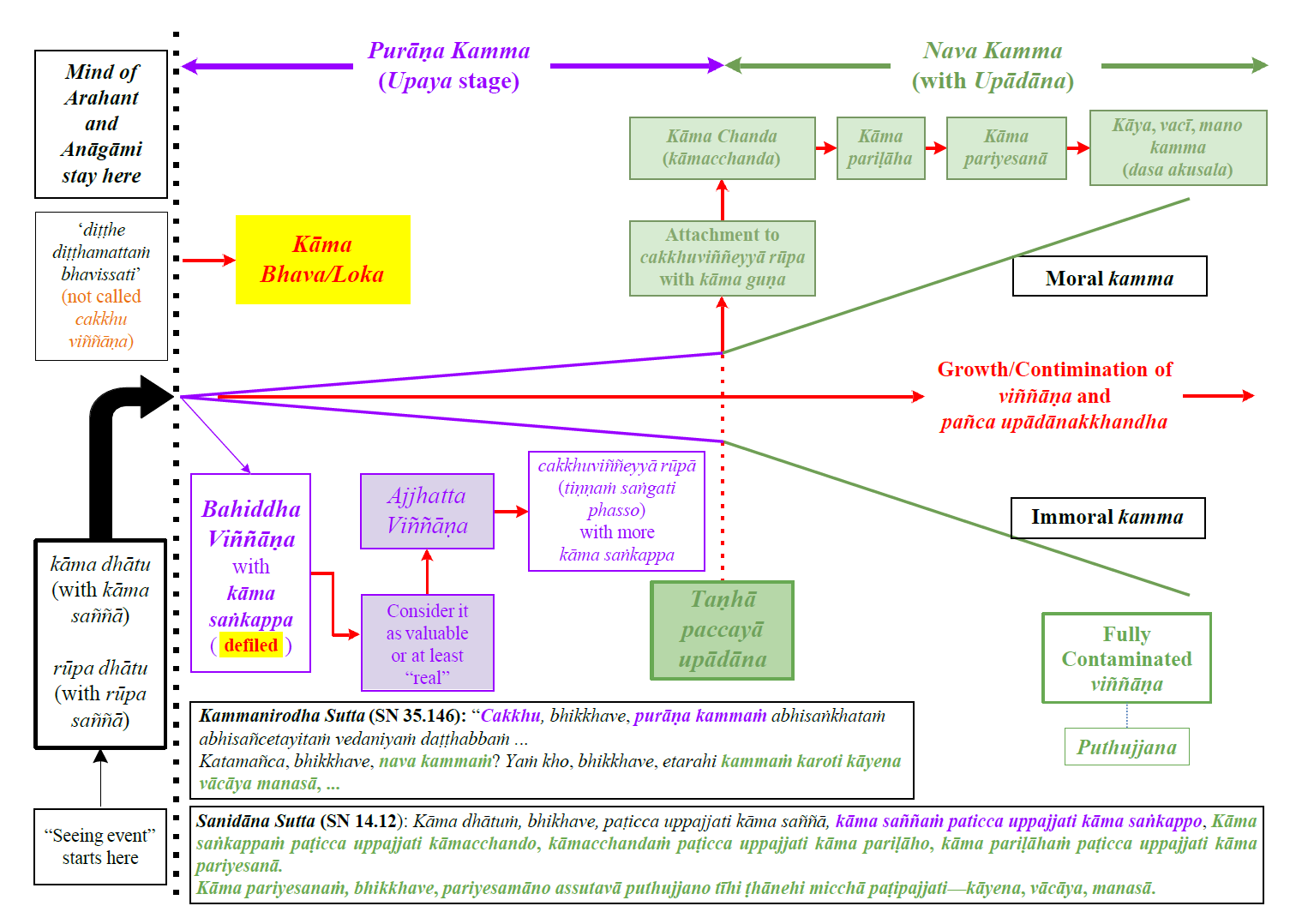
Download/Print: “WebLink: PDF file download: Purāṇa and Nava Kamma -2-revision 4”
Mind-Made ‘Samphassa-jā-Vedanā’ Leading to Taṇhā
12. The first, automatic attachment step was due to the subtle saññā/vedanā that automatically arose in the ‘kāma dhātu’ stage.
▪The second and stronger attachment (taṇhā) is fueled by more ‘mind-made vedanā’ arising in sensory inputs with enticing kāma guṇa. These are specifically called ‘samphassa-jā-vedanā.’
▪These stronger vedanā arise solely from ‘mind-grabbing’ sensory inputs.
13. A samphassa-jā-vedanā arises due to attachment via greed or hate at that moment (i.e., due to one’s gati).
▪“Samphassa jā vedanā” (this comes from “saŋ phassa jā vedanā”; it rhymes as “samphassa”) means this “contact with saŋ gati” leads to feelings. As we know, “saŋ” means defilements (rāga, dosa, moha) or fuel for the saṁsāric journey. See, “What is “Saŋ”? Meaning of Saŋsāra (or Saṁsāra)” and “Taṇhā – How We Attach Via Greed, Hate, and Ignorance.”
▪These are the vedanā (feelings) that Arahants do not feel. Since they do not have any “bad gati,” they do not commit any (abhi)saṅkhāra. The easiest way to explain this kind of vedanā is to give an example:
▪Three people are walking down the street. One has an ultra-right political bias (A), the second has an ultra-left preference (B), and the third is an Arahant (C) who has no particular feelings for anyone. They all see a prominent politician, hated by the political right, coming their way. It is a given that the sight of the politician causes A to have displeasure and B to have a pleasurable feeling. On the other hand, sight does not cause the Arahant to generate any pleasure or displeasure. Although all three perceive the person, they elicit different feelings.
Attaching to Kāma Guṇa Depends on the Mindset at That Moment
14. Unlike the first attachment in the ‘purāṇa kamma’ stage (which occurs automatically due to the unbroken saṁyojana), the above second attachment–which propels the mind to the ‘nava kamma’ stage – depends on the mindset (or gati) at that time.
▪Ancient yogis such as Āḷāra Kālāma avoided this step by refraining from ‘attractive sensory inputs’ that can trigger ‘kāma guṇa’ in the mind. They avoided ‘mind-pleasing’ sensory inputs by living in jungles, away from society filled with ‘enticing sensory inputs.’
▪That practice provides a temporary solution and could lead to rebirths in the Brahma realms if maintained until death.
▪However, it will not break the saṁyojana and lead to the attainment of magga phala. That can be done only by overcoming the first, automatic step in the ‘purāṇa kamma’ stage.
▪However, before that, one must overcome the second step (of attaching to ‘kāma guṇa’); remember that one must start at the ‘nava kamma’ stage and move toward the ‘Satipaṭṭhāna Bhūmi’ to attain magga phala; see “Paṭisotagāmī – Moving Toward Satipaṭṭhāna Bhūmi and Nibbāna.”
Avoiding ‘Enticing Sensory Inputs’ Is Helpful
15. Therefore, sensory restraint plays a critical role in cultivating the Noble Path. That starts in the ‘nava kamma’ stage, which we will discuss in the next post.
▪Even for overcoming attachment to ‘kāma guṇa’, avoiding enticing sensory inputs is quite helpful. Avoiding ‘attractive sensory inputs’ is one of the tools stated in the “WebLink: suttacentral: Sabbāsava Sutta (MN 2).” However, that will not be enough by itself; it is only one of the tools.’ This is why it is easier for bhikkhus to make progress on the Noble Path; they are required to stay away from sensory pleasures.
▪Therefore, the key steps toward Nibbāna/magga phala are: (i) stop generating ‘new potent kamma’ in the ‘nava kamma’ stage, (ii) overcome attachment to ‘kāma guṇa’ in the second step of the ‘purāṇa kamma’ stage, and (iii) overcome the ‘kāma saññā’ in the first step of the ‘purāṇa kamma’ stage. Then one enters the ‘Satipaṭṭhāna Bhūmi’ for the first time to attain the Sotāpanna stage. These steps are summarized in the “WebLink: suttacentral: Kammanirodha Sutta (SN 35. 146).” One should be able to follow that sutta with the above information.
▪Subsequently, a Sotāpanna can cultivate Satipaṭṭhāna so that they can regularly enter the ‘Satipaṭṭhāna Bhūmi’ (where kāma saññā is absent), where they can engage in Vipassanā and attain higher magga phala. This is shown in the chart below, which is from the post “Satipaṭṭhāna Bhūmi – Free of Loka Saññā.”
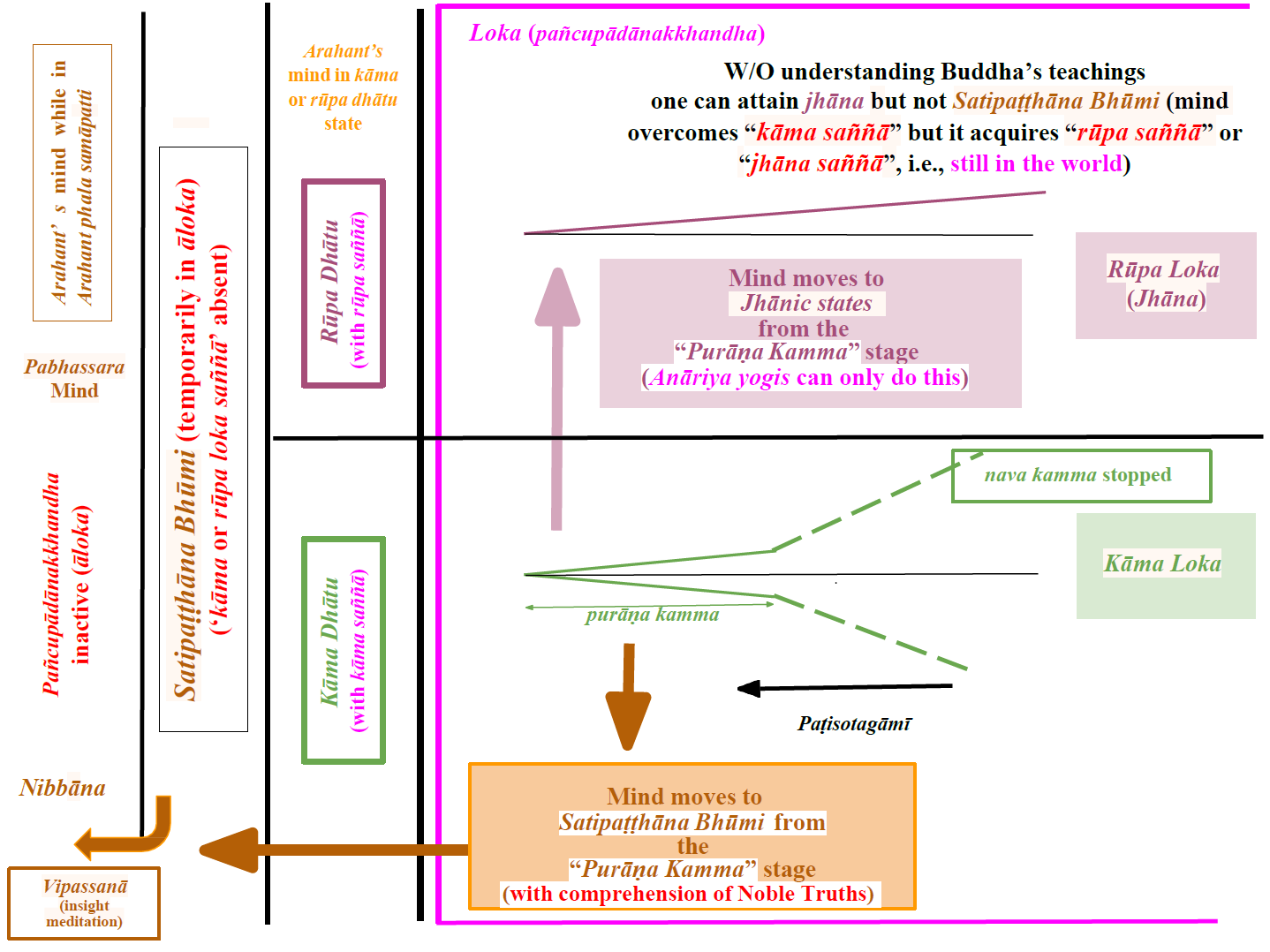
Overcoming Kāma Saññā - Satipaṭṭhāna Bhumi or Jhāna
Download/Print: “WebLink: PDF file download: Overcoming Kāma Saññā – Satipaṭṭhāna Bhūmi or Jhāna”
▪The background material is discussed in detail in “Satipaṭṭhāna Sutta – New Series.”
Summary
16. It is necessary to understand the following about the two steps of attachment that can occur in the ‘purāṇa kamma’ stage.
▪Anyone born with a human body will experience the ‘kāma saññā’ in the first step. A puthujjana’s (and anyone below the Anāgāmi stage) mind will always attach to any sensory input in this step. Even though the minds of an Arahant or Anāgāmi will also experience the ‘kāma saññā,’ their minds will not attach to it, because they have eliminated the first five saṁyojana associated with the kāma loka.
▪The second and stronger attachment (that generates taṇhā and upādāna and initiates the ‘nava kamma’ stage) may happen to a puthujjana (and anyone below the Anāgāmi stage) if the mind generates ‘samphassa-jā-vedanā.’ This second attachment occurs only in response to ‘enticing sensory inputs.’
▪Since the minds of an Arahant or Anāgāmi do not go past experiencing the ‘kāma saññā,’ their minds do not undergo both attachments.
▪Another key point: Ancient anariya yogis like Āḷāra Kālāma were able to avoid triggering ‘samphassa-jā-vedanā’ (and thus advancing to the ‘nava kamma’ stage; see #14 above. However, they were unaware of the initial attachment via ‘kāma saññā’ (only a Buddha can discover that) and thus were unable to escape the cycle of rebirth.