August 9, 2025; revised July 25, 2026 (#14)
Pañcupādānakkhandha of a puthujjana restarts at the moment of receiving a new sensory input. It always goes through the “purāṇa kamma” stage and may also enter the “nava kamma” stage. This growth of pañcupādānakkhandha (the same as the defilement of the mind) is called Anusotagāmī, or “flowing along with the rebirth process.” [See “WebLink: suttacentral: Anusota Sutta (AN 4.5)”] [anusotagāmī : adj. going with the stream; headed downstream; going with the flow [anu + sota + gāmī = “anu” means 1. “food” or “defilements” in most cases, or 2. “according to,” and sometimes 3. “through the understanding of Tilakkhaṇa,” “sota” means “stream,” and “gāmī” means “one who goes or leading to”; thus, anusotagāmī means “one who goes with the stream of defilements.”]]
Steps in the Contamination of a Mind
1. Adding to the existing pañcupādānakkhandha starts with receiving a new sensory input. This is equivalent to saying that the mind becomes active upon receiving sensory input. Then, the mind becomes progressively contaminated (within a split second) through several key steps. This is called ‘Anusotagāmī’ or ‘moving along the rebirth process.’
▪The mind is directed in that “wrong direction” due to the kāma saññā that arises automatically; see, for example, “Fooled by Distorted Saññā (Sañjānāti) – Origin of Attachment (Taṇhā).” Also, see the chart below.
▪A mind can reverse that process and go in the reverse direction (toward Nibbāna, i.e., ‘Paṭisotagāmi’) only by comprehending Buddha’s teachings.
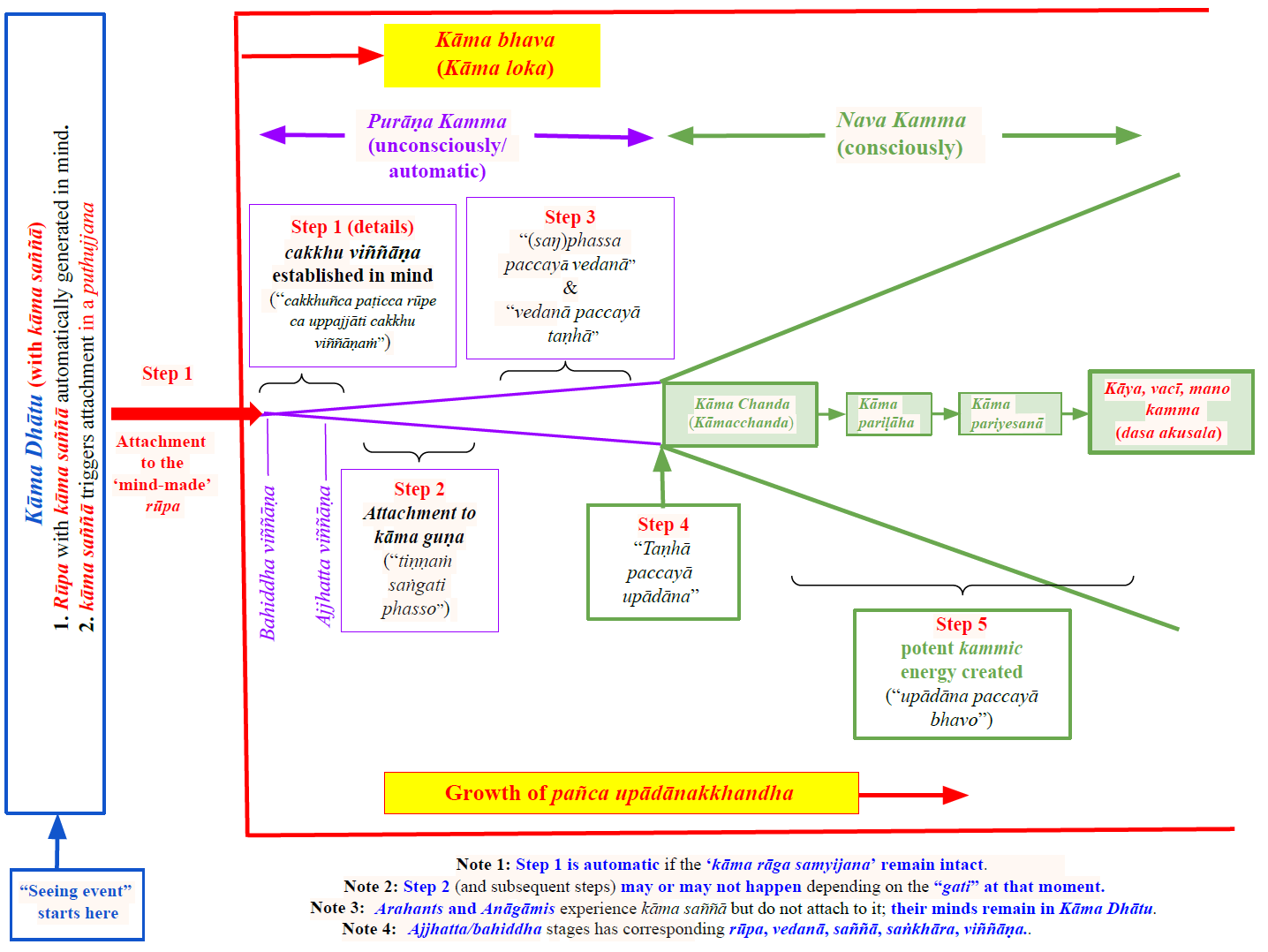
▪We started that discussion in #4 of “Satipaṭṭhāna – What Does It Mean?” and will finish it in this post. We used the following chart in that post.
Growth of Pañcupādānakkhandha - Revision 1
Download/Print: “WebLink: PDF file download: Growth of Pañcupādānakkhandha – Revision 1”
Step 1 – Automatic Attachment to the Kāma Saññā
2. New sensory input ALWAYS brings “kāma saññā” (“distorted saññā” in kāma loka) and the mind attaches to it if kāma rāga saṁyojana is unbroken (i.e., it happens to anyone below the Anāgāmi stage).
▪Based on that automatic attachment, that specific indriya becomes defiled, i.e., it is now an āyatana. For example, cakkhu indriya becomes cakkhu āyatana (same as “cakkhu” in most suttās), and cakkhu viññāṇa arises.
▪This is the first stage of cakkhu viññāṇa (the same as “bahiddha viññāṇa,” which is immediately elevated to “ajjhatta viññāṇa”); see #7 of “Purāṇa and Nava Kamma – Sequence of Kamma Generation.”
▪Simultaneously, the mind prepares its version of the external rūpa. This is the “cakkhu viññeyya rūpa” (meaning “the rūpa generated by cakkhu viññāṇa.”)
Step 2 – Attachment to Kāma Guṇa
3. Then the mind attaches to that “mind-made rūpa” (“cakkhu viññeyya rūpa”) based on one’s gati (remember “t” is pronounced as “th”) at that moment. That attachment is also automatic and is based on the “value” the mind places on that “mind-made rūpa,” and that determination is based on “kāma guṇa” (values of the six “evaluation criteria” relevant to kāma loka; see “Kāma Guṇa – Origin of Attachment (Taṇhā).”)
▪In this step, the attachment becomes stronger if the “state of mind” (or one’s gati) at that moment is conducive to pursuing that “mind-made rūpa.” This is when kāma rāga INITIALLY elevates to kāmacchanda, where the mind (still subconsciously) begins generating more sukha vedanā (known as “samphassa–jā–vedanā“), entering Step 3 below.
▪If the mind does not go through the second step, it will lose interest in that sensory input. If that is the case, the “mind contamination” (or the growth of the pañcupādānakkhandha) will stop. If that is the case, the mind will not proceed to the “nava kamma” stage.
Kāma Rāga in Step 1, Kāmacchanda Starts in Step 2
4. Before proceeding further, let us clarify the difference between kāma rāga and kāmacchanda.
▪Kāma rāga generation occurs automatically in Step 1 based ONLY on the status of kāma rāga saṁyojana.
▪In the first step, subtle/weak saṅkhāra (called “saṅkappa”) arise automatically, binding one to the kāma loka with kāma rāga. This initial step is discussed in detail in #4 and #5 of “Kama Guṇa – Origin of Attachment (Taṇhā).”
▪That discussion points out the following: As stated in the “WebLink: suttacentral: Nibbedhika Sutta (AN 6.63),” kāma (liking/attachment) arises ONLY with kāma saṅkappa: “Saṅkappa rāgo purisassa kāmo” OR “someone’s kāma is triggered and initiated by those saṅkappa” arising in Step 1.
▪For those who have eliminated the kāma rāga saṁyojana, even this Step 1 will not occur (because no craving for close sensory contacts of kāma loka; that holds for Arahants and Anāgāmis). This is equivalent to saying that a Paṭicca Samuppāda process will not be initiated with “avijjā paccayā saṅkhāra.”
▪In Step 2, kāma rāga becomes stronger with attachment to kāma guṇa, and it is elevated to an initial level of kāmacchanda.
▪We discussed Step 1 and Step 2 a little differently in “Satipaṭṭhāna – What Does It Mean?” It is a good idea to read that again to solidify the understanding.
Step 3- Generation of Taṇhā via Samphassa-jā-Vedanā
5. Thus, repeated attachment to the “mind-made rūpa” (“cakkhu viññeyya rūpa”) with perceived value (kāma guṇa) generates more kāma rāga with increasing sukha vedanā (which is really a saññā). This is a stronger version of the mind-made vedanā, known as “samphassa–jā–vedanā.”
▪As that sukha vedanā grows, kāmacchanda is elevated to increasing levels. At this point, the mind begins to focus on the sensory input with interest.
▪Thus, the mind keeps attaching to the “mind-made rūpa” and that is called “samphassa” (‘saŋ’ + ‘phassa’ or contact with ‘saŋ’ or defilements), and that also generates a sukha vedanā called “samphassa-jā-vedanā.”
▪This elevated level of “pleasure” leads to a firm attachment, which is known as taṇhā. This is the “vedanā paccayā taṇhā” (or “samphassa–jā–vedanā paccayā taṇhā”) step in Paṭicca Samuppāda.
▪Note that the mind can also become attached to a disliked sensory input through dosa or paṭigha. For example, upon seeing an enemy, one’s mind could generate a pañcupādānakkhandha based on anger. See “Taṇhā – How We Attach Via Greed, Hate, and Ignorance.”
▪For simplicity, we will consider attaching with like or kāma rāga.
Step 4 – “Taṇhā Paccayā Upādāna”
6. The mind is now fully committed to pursuing the sensory input with the conscious intention of extracting more “pleasure” from that sensory input.
▪This marks the transition to the “nava kamma” stage, specifically the “taṇhā paccayā upādāna” step in Paṭicca Samuppāda.
▪Furthermore, unlike in the “purāṇa kamma” stage, where kamma accumulation occurred automatically according to saṁyojana/anusaya and gati, kamma accumulation in the “nava kamma” stage is done consciously and deliberately.
▪However, for those without any understanding of the Buddha Dhamma, even the “nava kamma” stage seems fast and automatic. However, as we will discuss in the next post, with an understanding of Buddha’s teachings, this “nava kamma” stage can be controlled!
▪The mind becomes agitated in this drive to seek more pleasure. It wants to “hurry up and get it done” as quickly as possible.
Step 5 – Potent Kamma Accumulation in the “Nava Kamma” Stage
7. Kāmacchanda has now grown very quickly to a high level. In the “nava kamma” stage, it can be elevated to such a level that one is willing to do abhorrent acts (killing, raping, etc.) to satisfy one’s desires.
▪When one has developed kāma rāga to the kāmacchanda level, one becomes unaware of the harmful consequences of one’s actions. Kāmacchanda comes from kāma + iccha + anda, or “being blinded by sense attractions.” Here, “icchā” is liking, and “anda” is blind.
8. As shown in the chart above, Step 5 can be separated into three main stages: kāma pariḷāha and kāma pariyesana leading to generating potent kammic energies with dasa akusala via mind, speech, and the body (kāya, vacī, and mano kamma).
▪After the arising of kāmacchanda, the next critical stage is called “kāma pariḷāha.” There is a “burning sensation” or “burning desire” to fulfil one’s desire at this stage.
▪This is easily understood by considering an attachment with anger. Most “swift killings” done on the spur of the moment are done with uncontrollable anger. The mind becomes impatient to “get revenge” and will forget about the dire consequences.
▪Thus, one would now explore ways of fulfilling one’s desire. The mind will assess the ways to “get the job done” as soon as possible. This is the “investigative stage” or “kāma pariyesana” stage in the chart. Here, “pariyesana” means “to investigate.”
▪Again, “kāma pariyesana” also includes those based on anger and ignorance (because cravings and anger are rooted in avijjā, or ignorance).
9. That “investigation” will utilize all available faculties. One will consider the possibilities and their potential outcomes. Depending on the “urgency,” one may seek a quick outcome or one may start on a “long-term” plan.
▪If the mind gets “fully blinded” in a situation (rape is a good example), one would use all available ways to get it done without delay. One may lose all sense of decency and act like an animal.
▪In another scenario, one may initiate a long-term plan to burglarize a house. That would involve gathering information on who lives there and when they may be out of the house.
▪Such short-term or long-term planning may involve kāya, vacī, and mano kamma. Thus, one will think immorally of how to get the job done, may lie to get relevant information, and engage in immoral bodily activities.
▪Even thinking about how to get an immoral deed done is a potent kamma. Here, kammic energy is accumulated via vacī saṅkhāra. See “Correct Meaning of Vacī Saṅkhāra.”
Major Differences Between Purāṇa and Nava Kamma Stages
10. The “purāṇa kamma” stage is fast and automatic. Mind proceeds on “autopilot,” guided by unbroken saṁyojana and one’s mindset (gati) at that time.
▪Step 1 controlled by saṁyojana: A puthujjana has all five saṁyojana related to kāma loka intact. A Sotāpanna or Sakadāgāmi has eliminated three, and an Anāgāmi or Arahant has eliminated all five. Therefore, a puthujjana would have the strongest attachment in Step 1. A Sotāpanna attaches less strongly, and a Sakadāgāmi even less. An Anāgāmi or Arahant will not go through Step 1.
▪Step 2 controlled by Gati: For a puthujjana, Sotāpanna, or a Sakadāgāmi, the strength of Step 2 will decrease in that order, but will also depend on their mindset (gati) at that specific moment.
11. In contrast, stronger kamma accumulation in the “nava kamma” stage happens consciously; one is aware of what is happening.
▪Since a puthujjana starts off with a stronger attachment in the “purāṇa kamma” stage, they are likely to enter the “nava kamma” stage more often. They can accumulate even apāyagāmi kamma in the “nava kamma” stage.
▪A Sotāpanna or a Sakadāgāmi are likely to enter the “nava kamma” stage less often. Additionally, they will never engage in apāyagāmi kamma.
Pañcupādānakkhandha = Contamination/Defilement of a Mind
12. As we can see, the above-described process leads to an increasingly contaminated mind involving a series of automatic AND conscious processes.
▪The mind of a puthujjana ALWAYS starts in a defiled pañcupādānakkhandha state; that is because of “being fooled by the kāma saññā.” I keep pointing this out because this is a critical point: “Fooled by Distorted Saññā (Sañjānāti) – Origin of Attachment (Taṇhā).” The mind of an Arahant or Anāgāmi remains in the “kāma dhātu” state because their minds are not being fooled; see the charts above and below.
▪The events in the “purāṇa kamma” stage ALWAYS occur swiftly. We are not aware of this happening.
▪Once getting to the “nava kamma” stage, things can proceed quickly or slowly, depending on the level of attachment. One could kill another within a few seconds, for example, if a gun or a knife were readily available in a heated situation. Some tasks may take days or months, especially if they involve planning, as we discussed above.
▪As one begins to understand this “mind contamination process,” one will be able to “slow down the reaction time” by being mindful.
▪Then, at some point, one will be able to start the process of “moving in the reverse direction, towards Nibbāna.”
13. The initiation of a “new” pañcupādānakkhandha is the same as moving away from Nibbāna, i.e., progression of the mind toward a defiled state.
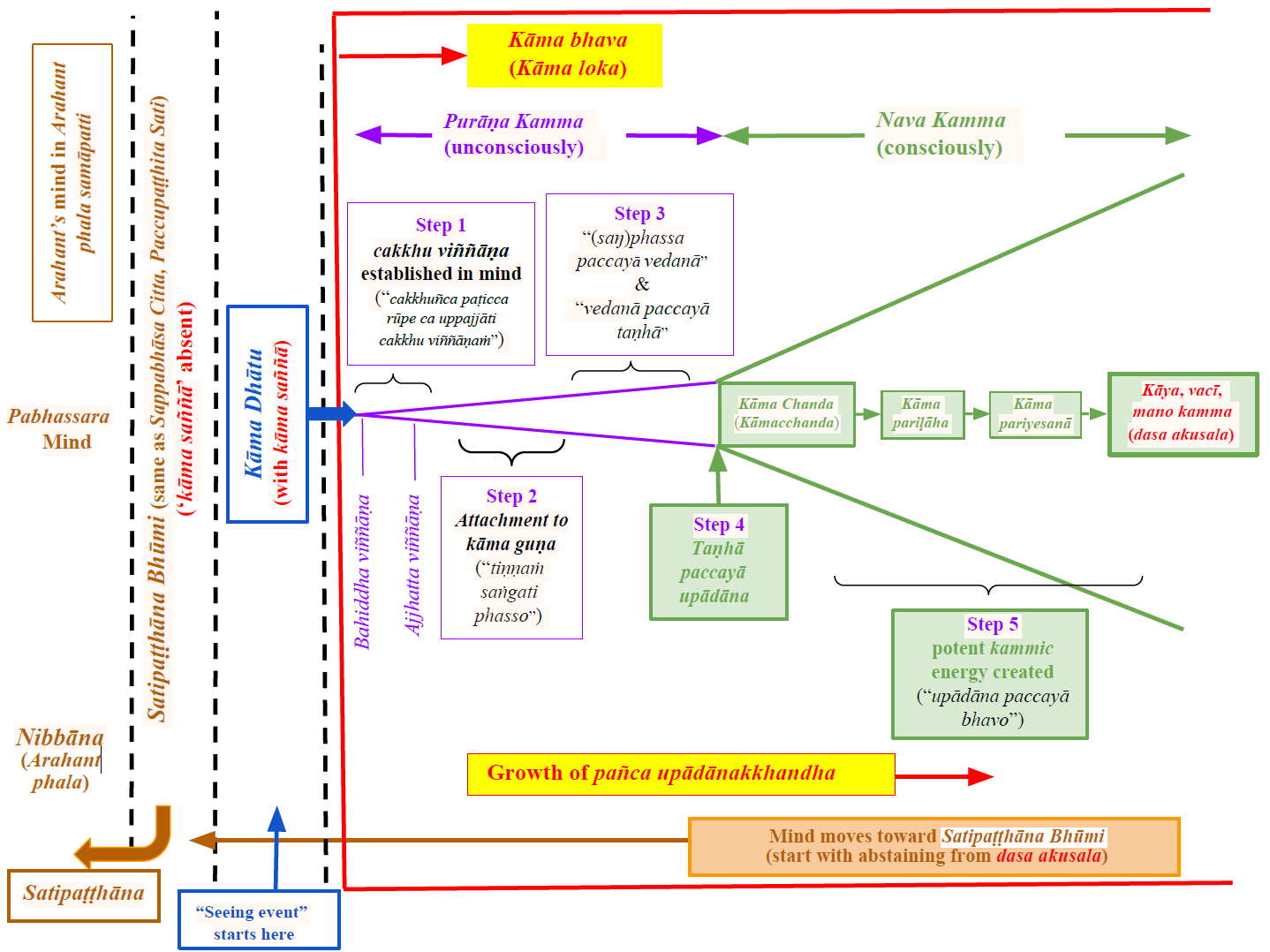
▪That is clearly seen in the second chart we discussed in “Satipaṭṭhāna – What Does It Mean?” I will reproduce that below.
Overcoming Kāma Saññā
Download/Print: “WebLink: PDF file download: Overcoming Kāma Saññā”
▪As we can clearly see from the chart, a mind ALWAYS moves AWAY from the Satipaṭṭhāna Bhūmi and Nibbāna (pabhassara mind) any time it attaches to a sensory input. This is what we referred to as “Anusotagāmī” above.
▪Yet, as we saw above, that cannot be avoided as long as the relevant saṁyojana remain intact or unbroken.
▪But if that initial attachment to the “kāma saññā” cannot be avoided, how can one ever attain Nibbāna?
▪We will discuss that in the next post. However, the start of that process is to “go backward” (“Paṭisotagāmī”), starting with a possibly (slightly) contaminated mind. Then, at some point, the mind bypasses the kāma dhātu and jumps over to the Satipaṭṭhāna Bhūmi; see the chart above. [paṭi : (adj.) prefix having the meanings; against; opposite, towards, in opposition to. “sota” means “stream,” and “gāmī” means “one who goes or leading to”.]
▪Let us discuss that briefly.
Reversing the Growth of Pañcupādānakkhandha – Paṭisotagāmī
14. The only way is to direct the mind to retrace the steps we discussed above and to stop the mind before getting to the “nava kamma” stage, i.e., not let the mind be blinded by kāma rāga or kāmacchanda. That can be done via sense restraint or “indriya saṁvara.”
▪Ancient yogis, such as Āḷāra Kālāma, were able to achieve that “first step.” They avoided temptations by living in jungles, away from sensory attractions and women.
▪However, they could not overcome the “purāṇa kamma” stage because they did not even know about it.
▪Only a Buddha can discover that “initial attachment process” (“purāṇa kamma” stage) and how to overcome it to get to the Satipaṭṭhāna Bhūmi and Nibbāna (pabhassara mind).
▪That is discussed in “Paṭisotagāmi – Moving Toward Satipaṭṭhāna Bhūmi and Nibbāna.”